Posts

Darkest Dungeon — forcing to play as intended

I first completed a run on Darkest Dungeon on Darkest difficulty sometime in 2020, 4 years after buying it sometime in 2016. I had attempted more than a dozen runs over the years with maybe up to 100 hours but couldn’t complete it until recently. DD is an interesting game where unless you played it as designed on an important dimension, it’s hard to actually complete a run. And the design being to treat the heroes as a commodity that you let die — just recruit more from the cart! (You can revive heroes at lower difficulty levels but at a high cost and infrequently.) This may be a slightly unfair thing to say about DD as my winning run had the lowest number of dead heroes; I just did more math in fights and played much more conservatively by exiting dungeons mid-instance when it started to look sideways. Even so a few of my starting heroes definitely went to the grave and I just had to trudge on with “the bigger plan”. It felt unnatural to an RPG player like me because in the genre perm...

Rogue-likes & F2P RPGs - A Surprisingly Good Combination

The biggest RPGs on the mobile market like Star Wars: Galaxy of Heroes, Marvel Strike Force and AFK Arena are all games that monetize on progression & collection. Power progression is fairly linear with little variance, with perhaps Summoner's War having the most diverse endgame through extensive customization through their Runes system. It is then surprising that another genre I love, rogue-likes, have found a home in many of these RPGs.  The essence of a rogue-like is its instance-based gameplay. This is why most advanced conversation around rogue-likes center around individual, independent "runs" with specific builds. One can complete a Watcher character run in Slay The Spire with a Pressure Points build, or an FTL run with a Crystal ship using the Flak Cannon. Rogue-likes often have a clear beginning and an end, and most of the time if you make it to the end you'd have managed to assemble a pretty impressive build. Apart from the difference in progression stru...

Losing users to RNG

I saw this great video clip illustrating binomial distribution  and was reminded of a lengthy discussion I had with an engineer colleague while designing a distribution balance for loot drops. I wanted to implement a chance floor mechanic so players would not get too unlucky and he was miffed because he thought it redundant, as "everything regresses to the mean in the long run anyway". It was difficult to convince him and he had to build a simulator before understanding my point. If you set something to drop at a 20% rate per attempt, the long term average would be 5 attempts per acquisition but there would be plenty of individuals who had to make 10 attempts or more. At the extreme, given thousands of individuals, there would probably be some whom had to make 20 or more attempts to acquire said drop. The user population is unlikely to feel this when an "attempt" is very short and frequent, like a 2-3 second kill on an enemy mob with hundreds of instances in a l...

Why Loot Boxes?

Image
I've been working on RNG drop and specifically loot box design a lot more in recent years and I began to wonder on an essential question -- why are loot boxes so widely used in F2P games?  As a psych major, when I first started working in F2P back in 2007, I thought of loot boxes as effective purely because variable rate schedules are more effective in reinforcing behavior . This is the same mechanic that makes gambling a compelling activity, and the usage of this design is probably at the heart of all complaints about F2P games being predatory. As I was working on a loot box drop rate though, I realized I had missed an equally basic and powerful aspect of loot boxes: pricing.  Many contemporary F2P games which have loot boxes at their heart like Overwatch, AFK Arena and Empires & Puzzles often price a single loot box in the ball park of US$3. If a particular item within the loot box has a drop rate of 5%, it would take an average of 20 rolls to acquire one,...

Learning through Balance: Slay the Spire

Image
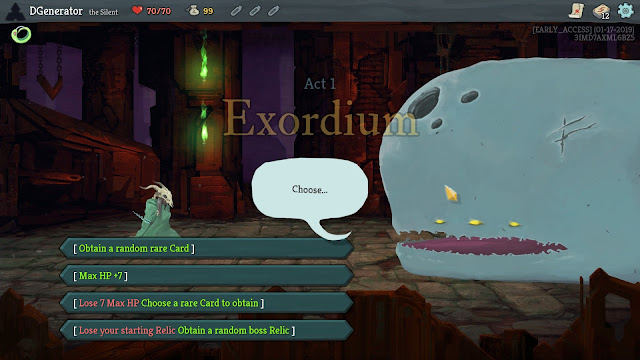
I completed Act IV of Slay the Spire a few days ago after encountering the final boss a little less than 10 times. It's a great rogue-lite and what was interesting was how I learned one of the most important parts of the game. First, some context. Slay the Spire is a rogue-lite + deck builder mashup. In combat, players start with ~20 cards in their decks and a subset of 5 is drawn from their deck every turn. Players have a mana budget each turn and each card has its own mana cost. Used and unused cards every turn are mostly returned to a pile that can be drawn from after the initial draw pile is exhausted. At the end of most battles the player has an opportunity to choose a card from three to add to their decks. The beginner's inclination is to constantly add new cards, because most of them are pretty cool, allow combo opportunities and individually stronger than your default deck. Deck size turns out to be critical for the player because your draw size stays the same unl...

Auto Chess; Drodo cornered

The Auto Chess genre is on fire. The original DOTA Auto Chess by Drodo Studio kicked off the storm and quickly surpassed 300,000 concurrent players . At breakneck speed, both Valve and Riot Games have launched their own Auto Chess inspired spins and both have grown very quickly . Today, it is probable that both Riot and Valve's versions have surpassed Drodo's in active players. The only piece we await in this contest is Riot's delivery of a mobile version, which will be their first successful product on mobile. As usual, Blizzard will be too late. The big question for me: Is this war over? And did Drodo let the win go? I'm a big fan of Drodo and have reached Bishop-6 on Drodo's mobile Auto Chess Origins which launched on iOS Jun 5, 2019. They've accomplished a dream of many studios to create a new genre with a massive global audience. This is a moment reminiscent of the birth of MOBA on the Warcraft 3 mod scene and history looks to repeat itself with ...